

The Software Handled the Logistics. My Nephew Handled the Rest.
JoeyCo removed the friction so my nephew and an aging couple could just be in relationship. That relationship is the intervention no clinic can prescribe.

SUNDAY SHARE | RELATIONSHIP + SOFTWARE
Opinions are my own and do not represent my employer.
My nephew Nanik became the first Joey.
JoeyCo is a small app with a simple job. It matches homeowners who have a spare bedroom with college students who trade a few hours of light help for a lower rent. Roughly 60% of American homes have at least one unused bedroom. The inventory was always there. So were the students who cannot afford Bay Area rent, and the older couples who could use a hand and a little company. What was missing was a safe way for any of them to find each other.
Nanik got matched with the Millers.
Here is the part that stayed with me. When he was asked about the arrangement, he did not talk about the rent. He said it does not feel like a chore to lend a helping hand. And when Robert Miller was asked what worried him going in, it was not the paperwork or the money. It was whether his wife would be comfortable with someone new in the house.
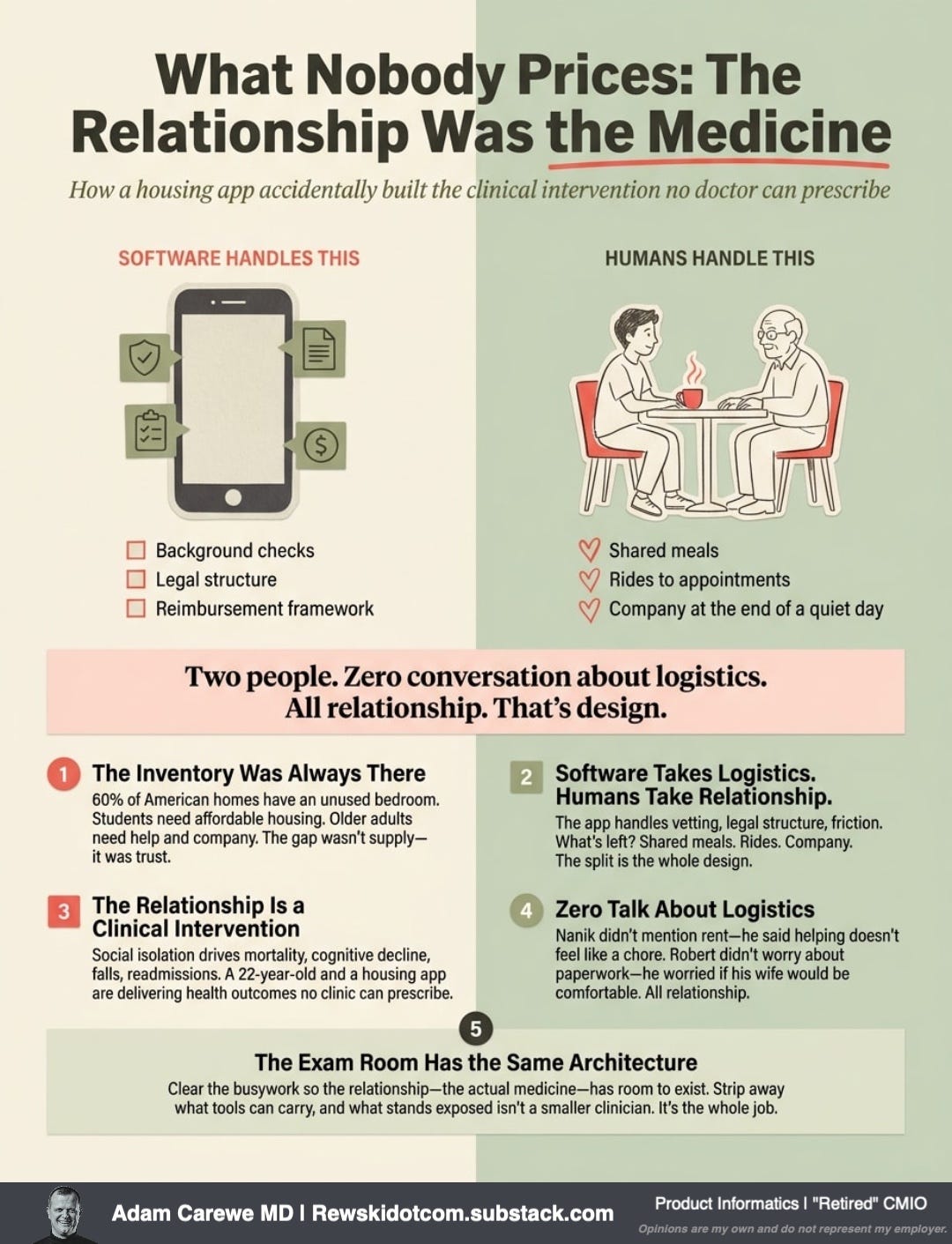
Two people. Zero conversation about logistics. All of it about the relationship.
That is not an accident. That is design.
The Problem Was Never the Bedroom. It Was the Trust.
It would be easy to read JoeyCo as a housing story. Cheaper rent, filled rooms, a clever workaround for an expensive market. That framing misses what actually got built.
The bedrooms already existed. The need already existed. The match that made Nanik and the Millers a good fit existed before the app opened. None of that was the hard part.
The hard part was trust. A student does not move in with strangers on a handshake. An 80-year-old does not hand a housemate the key to the room next to his wife on good vibes. Between the two of them sat a wall of unanswered questions. Who is this person. Are they safe. Who is responsible if something goes wrong. Every one of those questions is a reason to not cross the intersection, even when both sides would be better off on the other side.
JoeyCo did not build a bedroom. It built the trust that let two people use one.
I keep coming back to this in my own practice. The thing standing between a patient and what they need is often not a shortage of care. The clinician exists. The follow-up exists. What sits in the gap is a wall of logistics and unanswered questions. The shortage is not care. The shortage is trust-in-ease.
The Architecture Is a Split. Software Below. Humans Above.
Look at how JoeyCo actually divides the work.
The software takes the logistics. The vetting. The background checks. The reimbursement structure engineered so the whole arrangement stays on the right side of labor law. All the friction that would otherwise poison a new relationship with suspicion and paperwork, the app quietly absorbs.
The humans take the relationship. The shared meals. The ride to an appointment. The company at the end of a quiet day. The part no software can do and no software should try to.
That split is the whole design. And I have felt the smaller version of it in my own visits.
When the chart is ready before I walk in, the reconstruction falls away, and what is left is the part that was always the point. I spent three Monday Full Stacks last month walking through exactly this, one exam room at a time. Preparation clears the busywork. Presence becomes the instrument. Judgment is the layer nothing else reaches. Strip away everything the tools can carry, and what stands exposed is not a smaller clinician. It is the whole job.
JoeyCo built that same split into a housing app. The software holds the logistics. The humans hold the relationship. A tiny startup shipped the architecture I keep describing from the exam room.
What Nobody Prices: The Relationship Was the Medicine.
Here is the part the housing framing never counts.
When Nanik carries the groceries in and sits down to a meal, that is not a rental amenity. That is a clinical intervention. Social isolation in older adults tracks with higher mortality, faster cognitive decline, more falls, and more hospital readmissions. Connection and a second set of hands in the home are two of the most reliable predictors of aging in place well. A housing app, staffed by a 22-year-old, is delivering an outcome no clinic can write a prescription for.
Sit with that. The most valuable thing happening in that house is health. It is happening entirely outside the healthcare system, enabled by software that never says the word.
This is the subtraction I keep landing on. In the visit as I live it, the relationship gets built in the minutes left after the logistics take their cut. It never fits. It never did. The future I want is not a harder squeeze on those minutes. It is the busywork moving off me, so the relationship, the actual medicine, finally has room to exist. That is not a diagram. It is a Tuesday afternoon where I got to be present, because something else carried the load.
We keep trying to fix the visit by cramming more into it. The thing I actually want is everything else getting out of the way.
One Caveat Worth Naming
Software that removes friction can also remove the human, if you let it. That is the failure mode, and it is a real one.
JoeyCo’s discipline is that it automates the vetting, not the visit. It builds the trust layer and then steps back. It never tries to be the housemate. The day an app like that decides it should be the relationship instead of enabling it, the whole thing collapses, because the relationship was the point.
The exam room has the same rail. Clear the logistics. Never automate the relationship. The moment the tool tries to be the doctor instead of clearing the floor for one, trust does not hold. It breaks.
Nanik did not get a cheaper apartment. He got a reason to show up for someone. The Millers did not get a tenant. They got a person at their table. The software made one intersection safe to cross. What it could not do, and should never try to do, was walk across for them.
That is the future I want to practice in. Clear the logistics. Leave the relationship to the humans, because the relationship was always the medicine. Do that, and a thousand unmarked intersections between a patient and the care they need become crossable. My nephew found one of them first.
— Adam
If this resonated, I made the same case from inside the exam room across three Monday Full Stacks: Preparation Is Not the Visit, Presence Is Diagnostic, and Judgment Is the Last Layer. This Sunday piece is what that argument looks like out in the world.
The relationship was never the bottleneck, the friction was. Software should quietly remove the logistics so clinicians and patients can focus on what only humans can do.
I think you will enjoy my post tomorrow morning, if you have a moment would like your thoughts,
Chris