

Presence Is Diagnostic
Part 2 of 3 | The attention preparation hands back is not recovered time to fill. It is the most sensitive instrument in the room.

Opinions are my own and do not represent my employer.
Part one ended on a question. What do you do with the attention you just got back?
Most answers get it wrong on the first word.
They call the recovered attention bedside manner. A courtesy. The soft part of the visit.
It is not soft.
Attention is the most sensitive instrument in the room, and presence is how you switch it on.
This is part two of a three-part series, running three Mondays. Part one was about what preparation clears. This one is about what the cleared attention is actually worth.
What attention gets mistaken for
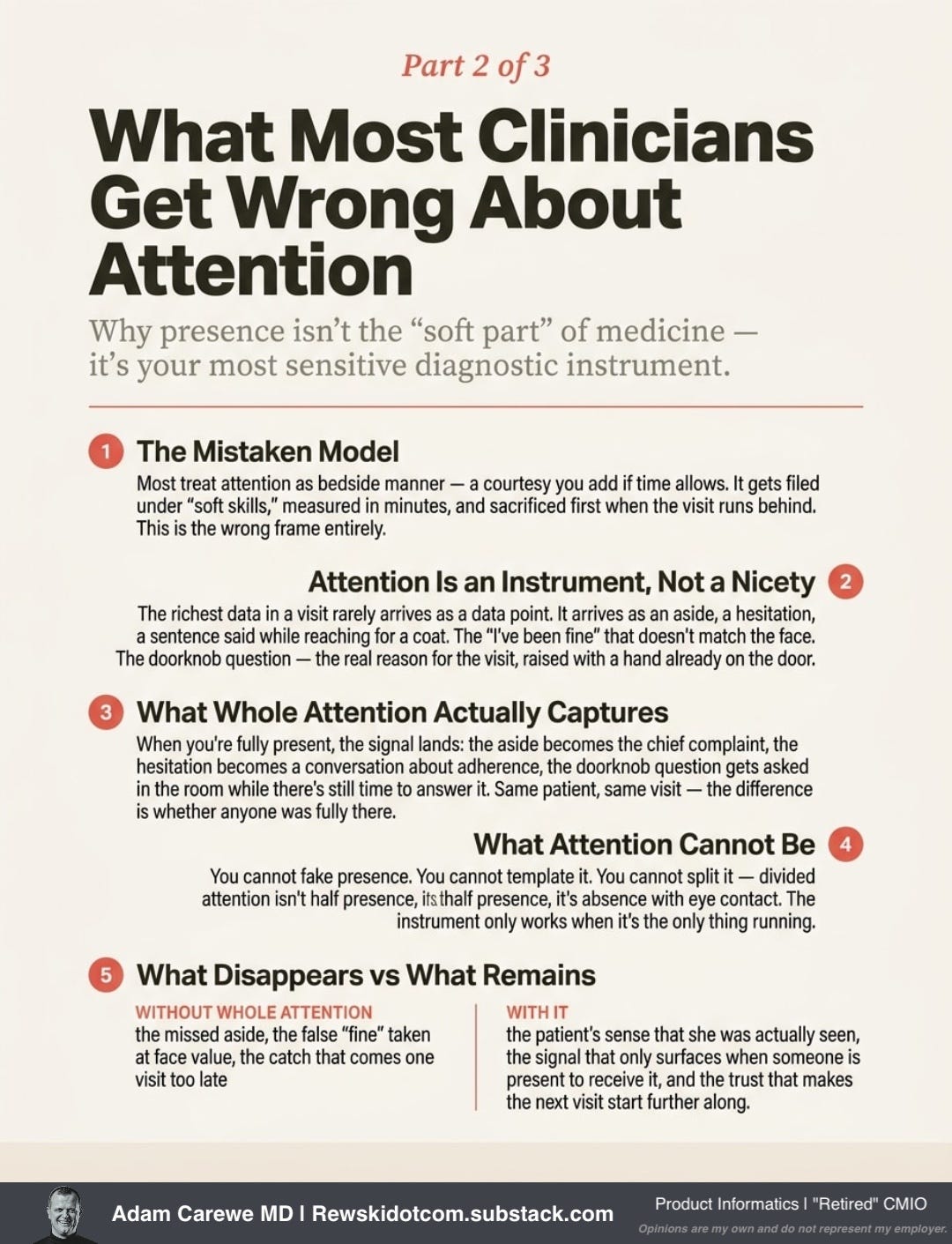
The mistaken model treats attention as warmth, warmth as optional, and optional as the first thing to cut.
It gets filed under bedside manner, as if it were etiquette.
It gets measured in minutes, as if more time were the same as more presence.
It gets sacrificed first when the visit runs behind.
Each of those treats attention as a nicety. It is an instrument, and a precise one.
What attention actually does
It captures the signal the chart cannot hold.
The richest data in a visit rarely arrives as a data point. It arrives as an aside. A hesitation. A sentence said while reaching for a coat.
The “I have been fine” that does not match the face.
The worry tucked inside a longer update, mentioned once, never repeated.
The doorknob question: the real reason for the visit, raised with a hand already on the door.
None of those is in the prepared chart. All of them change the medicine. Presence is what lets me catch them, because catching them requires that nothing else be running.
This is also where ease earns its keep. When the visit feels easy, the patient says the true thing. Ease is not comfort for its own sake. It is the condition under which the real history comes out. That is trust-in-ease at the bedside. The patient trusts the encounter because it is easy to be heard, and the trust is what unlocks the disclosure.
What attention can never be
Here is the rail.
Attention cannot be faked, scheduled, or divided.
You cannot template presence. A scripted warmth reads as a script.
You cannot split it. Divided attention is not half presence. It is absence with eye contact.
It does not survive multitasking. The instrument works only when it is the only thing running.
This is why the reconstruction layer mattered so much in part one. Every minute spent assembling the patient was a minute the instrument was switched off.
How the visit changes when attention is whole
Without whole attention, the signal slips:
the aside slides past
the hesitation reads as agreement
the doorknob question gets asked in the parking lot, to no one
With whole attention, the signal lands:
the aside becomes the chief complaint
the hesitation becomes a conversation about whether she is actually taking it
the doorknob question gets asked in the room, while there is still time to answer it
Same patient. Same visit. The difference is whether anyone was fully there to receive what she was already saying.
What disappears, what remains
What disappears:
the missed aside
the false “fine” taken at face value
the catch that comes one visit too late
What remains:
the patient’s sense that she was actually seen
the signal that only surfaces when someone is fully present to receive it
the trust that makes the next visit start further along
The disappearing list is everything that slips past a divided clinician. The remaining list is why presence was never the soft part of the job.
Preparation handed the attention back.
What we call it next decides what it becomes.
Treat it as recovered time, and it fills with the next task.
Treat it as the instrument it always was, and the visit gets better at the one thing no chart can do, which is noticing.
So the question is not whether we have more attention now. It is whether we spend it on the patient or on the queue.
This is gold and should be required reading for every residency in America. I can't tell you how many "door knob" moments I have had over the years that ended up being the diagnostic difference maker.