

Judgment Is the Last Layer
Part 3 of 3 | Strip away the reconstruction and the divided attention, and what is left is the one call no chart prepared and no rule can reach.

Opinions are my own and do not represent my employer.
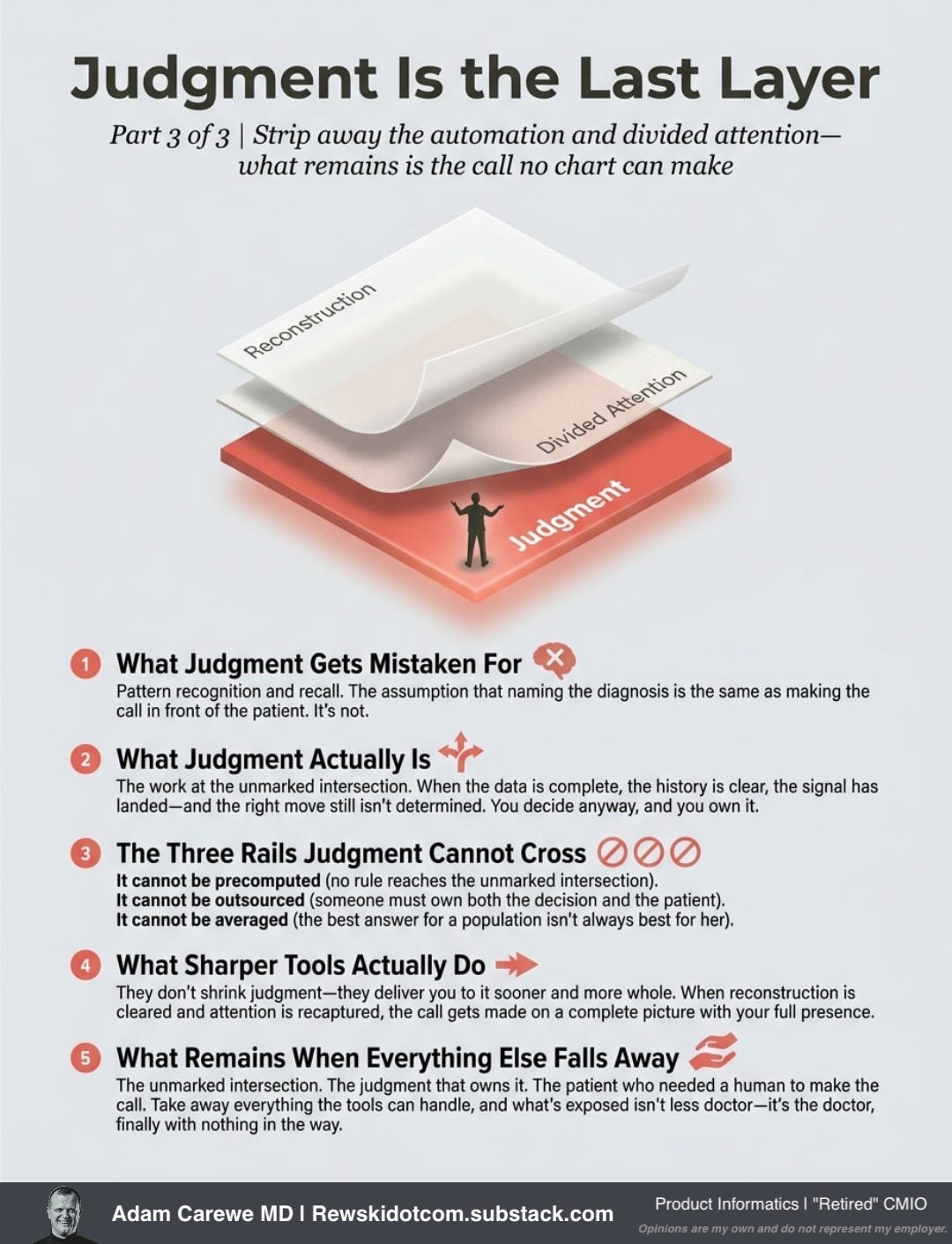
Two pieces in, the visit has been stripped down.
Preparation cleared the reconstruction. Presence captured the signal.
Take both away and something is left that will not come away.
It is the decision. The call no chart prepared and no aside resolved on its own.
This is where the medicine actually lives.
This is part three of a three-part series, running three Mondays. Part one cleared the reconstruction. Part two recovered the attention. This one is about what remains when both are done, and why it does not reduce.
What judgment gets mistaken for
The mistaken model says judgment is pattern recognition, pattern recognition is mechanical, and mechanical things are the next to go.
That treats the call as recall, as if naming the pattern were the same as choosing in front of the patient.
It treats the guideline as the decision, as if the rule and the room ever fully agreed.
It treats the hard part of the visit as the part a sharper chart erases.
The room disproves all three the moment the inputs are complete and the answer still is not.
What judgment actually is
It is the work at the unmarked intersection.
An unmarked intersection is the point in a visit where the data is in, the history is clear, the signal landed, and the right move is still not determined. No sign tells you which way to go. You decide anyway, and you own it.
The lab is normal and she is not.
The guideline says start it and she will not take it.
Two problems compete and only one can be the focus today.
These are the thousand unmarked intersections of a real encounter. The chart can hand you every fact about a person and still hand you none of these calls. Judgment is choosing well precisely when everything has been presented and nothing has been decided.
What judgment can never be
Here is the rail.
The call cannot be precomputed, outsourced, or averaged.
It cannot be precomputed. The intersection is unmarked because no rule reaches it. If a rule reached it, it would not be the hard part.
It cannot be outsourced. Someone has to own both the decision and the patient sitting in front of it, and those cannot be held by different hands.
It cannot be averaged. The best answer for a population is not always the best answer for her, and the visit is where that difference gets honored or erased.
How the visit resolves when the tools are sharp
Without the reconstruction cleared and the signal captured, the intersection arrives late and under load:
the call gets made on a half-assembled picture
the deciding happens while you are still listening for the story
judgment competes with bookkeeping for the same minute
With both done, the intersection arrives early and with full attention:
the call gets made on a complete picture
the deciding gets the whole clinician
judgment is the only thing still running
Sharper tools do not shrink the judgment. They deliver you to it sooner, and more whole.
What disappears, what remains
Across three Mondays, the same subtraction.
What disappeared:
reconstruction
divided attention
the busywork that kept disguising itself as the visit
What remains:
the unmarked intersection
the judgment that owns it
the patient who needed a human to make the call
The series was a subtraction the entire time. Take away everything the tools can take, and what is exposed is not less doctor. It is the doctor, finally with nothing in the way.
For three Mondays the argument has run one direction.
Every layer the tools clear makes the human layer more visible, not less.
The fear was that preparation would shrink the doctor.
The opposite happened. It uncovered her.
So the prepared visit leaves one question on the table, and it is the only one worth asking: when everything that can be handled for you is handled, are you ready to be the part that cannot?
The idea of the "unmarked intersection" is a powerful way to describe where medicine actually happens. It also highlights something easy to overlook: judgment doesn't improve simply because more information is available, it improves when clinicians have the time, attention, and responsibility to own the decision. The more we remove the friction surrounding the visit, the more visible that uniquely human work becomes. That's a distinction worth preserving and protecting.