

The 3-Layer Communication Stack: How to Rebuild Care Messaging from the Ground Up
Making healthcare efficient, humane, and scalable—one redesigned workflow at a time.

If you were designing healthcare communication today—no legacy systems, no inboxes, no “portal messages” - would you invent asynchronous secure messaging?
Probably not.
You’d build a triaged communication network, where every patient question lands at the right level of automation, human support, or clinical expertise.
Fast for patients. Focused for clinicians. Scalable for systems.
So why haven’t we done it?
Because we’re still trying to fix the InBasket instead of replacing the paradigm.
I touched on this subject last week and expand on the concepts below.
The Portal Inbox: A Feature That Outlived Its Purpose
Secure messaging was a breakthrough—15 years ago. Kaiser Permanente did it before EPIC even had MyChart! It bridged a gap when phone calls and office visits were the only options.
But now, that same feature is the source of:
InBasket fatigue
Role confusion
Delayed responses
Diminished trust (“Why hasn’t anyone responded yet?”)
It’s not the volume that’s the problem.
It’s the architecture.
Messages flatten context and collapse triage. Everything looks the same.
A refill request and a chest pain question arrive with identical urgency.
No modern communication system works like that—not logistics, not software, not customer success. Only healthcare still funnels everything into one inbox and calls it “patient engagement.”
From Inbox to Stack
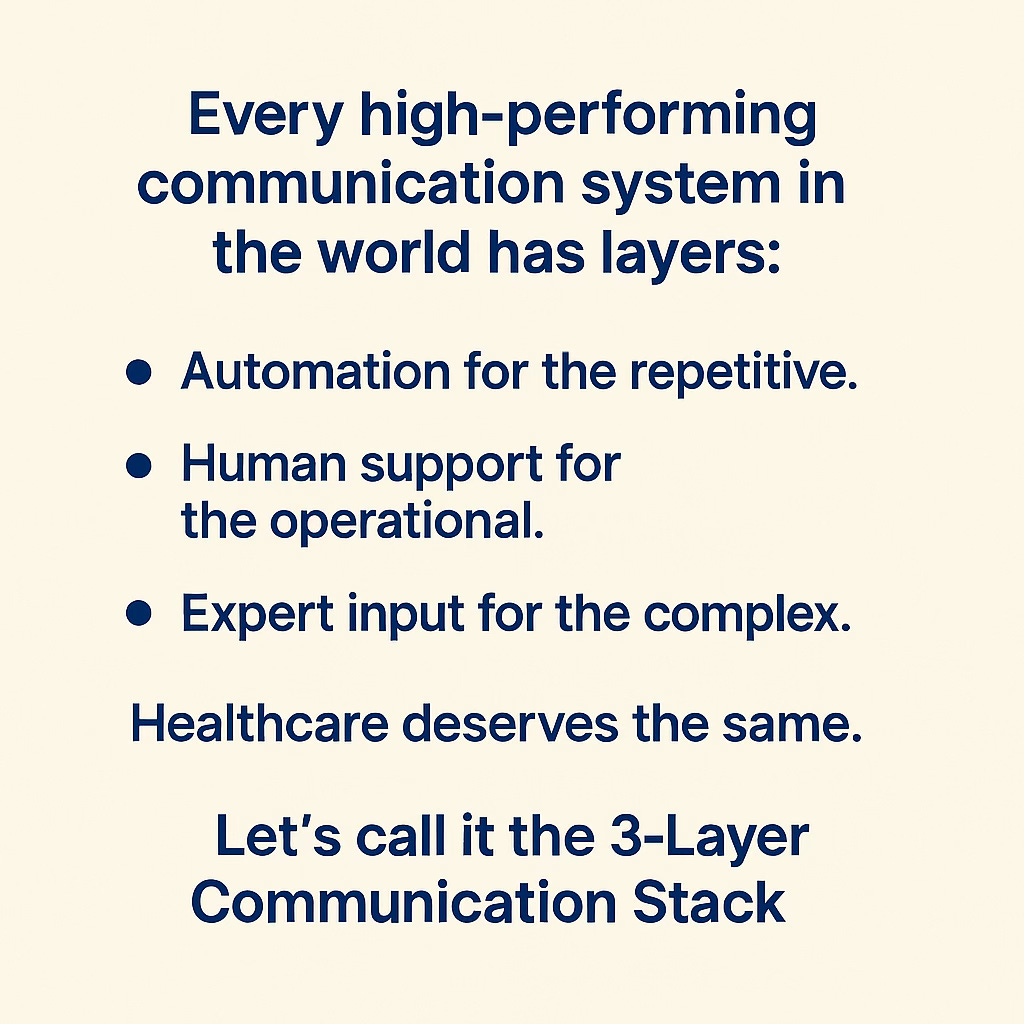
Every high-performing communication system in the world has layers:
Automation for the repetitive.
Human support for the operational.
Expert input for the complex.
Healthcare deserves the same.
Let’s call it the 3-Layer Communication Stack.
Layer 1: The Bot Layer — Instant, Contextual, Safe
Think of this as the “self-driving” tier. Its job: handle everything that can be answered with structured data, predefined logic, or LLMs with solid guardrails.
Examples:
“What’s the status of my referral?” → Pull from scheduling data.
“When were my last diabetes labs?” → Query recent lab results.
“Can I get a refill?” → Check protocol, auto-route to pharmacy if safe.
Requirements for this layer:
✅ Natural language understanding (not keyword menus).
✅ Tight EHR data integration.
✅ Guardrails for clinical scope.
Design challenge: Build trust through transparency. Patients should see the bot’s confidence level and escalation triggers, not guess if they’re talking to a human.
Layer 2: The Human Ops Layer — Responsive, Coordinated, Empathetic
This layer replaces the “lost message” middle zone: things too nuanced for a bot but not clinical enough for a doctor.
Staffed by medical assistants, nurses, or care navigators. Powered by clear workflows, macros, and smart routing.
Examples:
“My medication isn’t at the pharmacy.”
“I’m out of test strips; who should I call?”
“I need to change my appointment.”
The ops layer creates continuity—real humans closing loops fast, without burning out clinicians.
Design challenge: Empower this team with a unified dashboard (not 6 systems) and clear handoff rules. Every escalation to a clinician should be context-rich—like a triage note, not a new mystery message.
Layer 3: The Clinical Layer — Judicious, High-Signal, Context-Aware
This is where the physician or advanced clinician finally enters the picture—only when judgment is needed.
By the time an issue hits this layer:
The question is clearly framed.
Background info is attached.
The clinician can decide, not decode.
Think of this as asynchronous telemedicine, not messaging. You’re not parsing “Hi doc…” messages. You’re making micro-decisions in a structured, high-signal channel.
Design challenge: Shift from “responding” to “resolving.” Build UI that makes the next step (order, message, note, follow-up) one click away.
Why This Stack Works
1️⃣ Speed for patients.
They get instant answers for routine things and human acknowledgment when needed. No more wondering if their message disappeared into the void.
2️⃣ Focus for clinicians.
Physicians touch only what truly requires them—and when they do, it’s clean, contextual, and quick.
3️⃣ Scalability for systems.
Every layer is measurable, improvable, and automatable. You can tune staffing and tech investment precisely where it adds the most value.
The Real Innovation Isn’t AI — It’s Architecture
Most startups are chasing inbox cleanup tools: AI summarizers, message prioritizers, billing for replies.
That’s optimizing the wrong layer.
The breakthrough will come from architectural design—systems that route intent in real time across these layers.
This is what Slack did for internal comms, what Intercom did for customer support, and what modern triage platforms did for emergency response.
Healthcare just needs its version—purpose-built for regulated data, clinical nuance, and patient safety.
The goal isn’t “inbox zero.” It’s inbox obsolescence.
The Design Prompt for Builders
If you’re working on communication tools for healthcare, here’s your challenge:
Design for triage, not transmission.
Start every new feature by asking:
What layer should this live in?
How does it hand off safely?
How does it make context visible?
If you can answer those, you’re not building another messaging product.
You’re building infrastructure for continuous care.
Takeaway:
The InBasket isn’t a workflow to optimize. It’s a relic to retire.
The future of patient communication will be built on layered, intelligent triage systems—bots for speed, humans for empathy, clinicians for precision.
We don’t need smarter messages.
We need smarter systems.