

NFF: The Cuff Was Always a Sample
A national hypertension society wrote a continuous cuffless ring into its guideline, and the snapshot reading just lost its monopoly on the truth.

Opinions are my own and do not represent my employer.
Source: 2026 Korean Society of Hypertension Guidelines, 6th Edition.
● THE SIGNAL
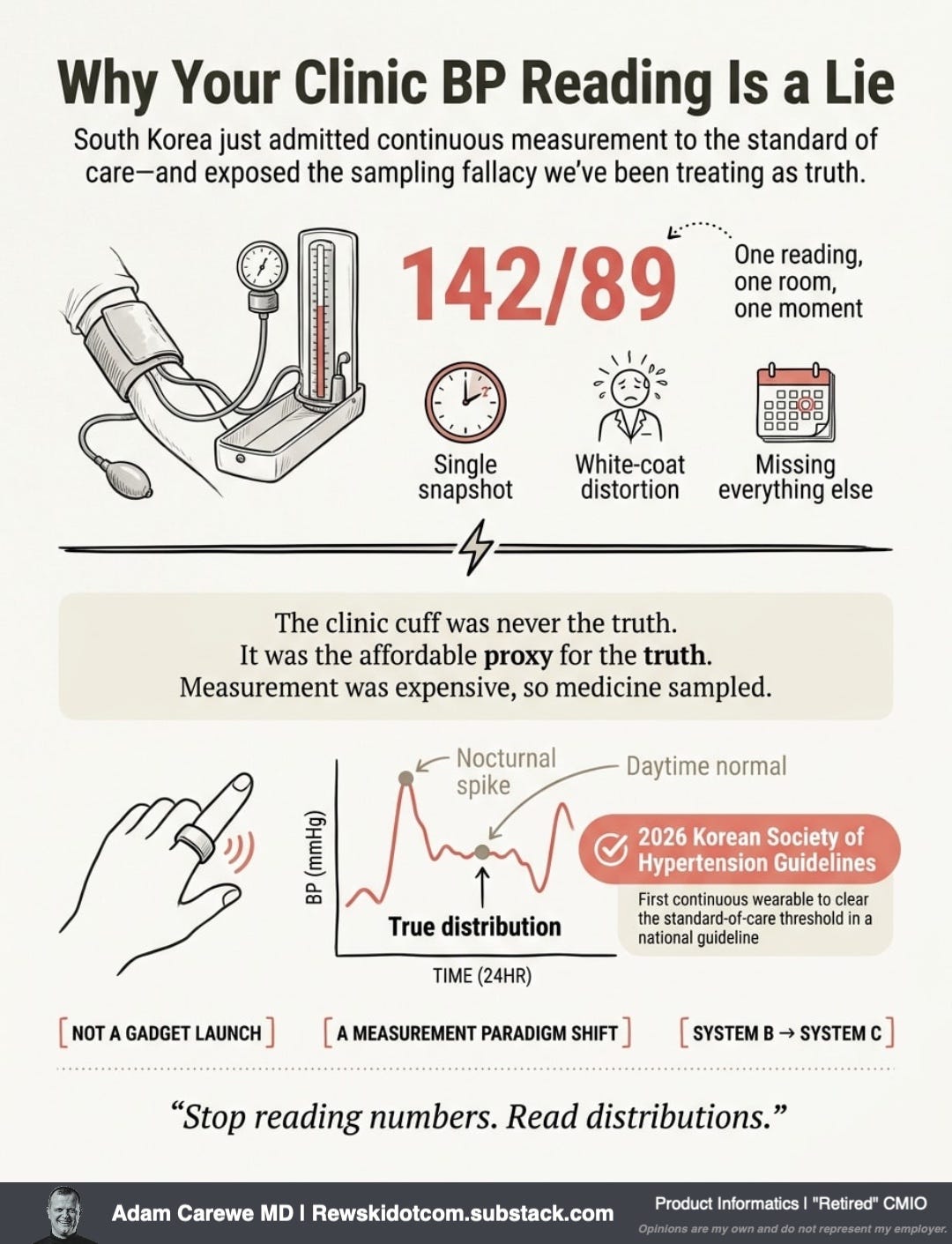
South Korea’s national hypertension society added a ring-type cuffless monitor to its clinical guideline. It is the first time a continuous wearable has cleared that bar in a national standard.
The bar is the story. Guideline inclusion is the threshold consumer devices almost never cross. Step counts and heart-rate alerts live in the wellness aisle. This one entered the standard of care for a leading driver of stroke and heart disease.
● THE NOISE
The headline reads as one more gadget. Your ring checks your blood pressure now. Wearable hype, consumer wellness, another sensor on another finger.
That framing buries the actual event. The device is not the news. The threshold it crossed is the news.
● THE REFRAME
The clinic cuff was never the truth. It was the affordable proxy for the truth. One reading, in one room, at one moment, standing in for a number that moves all day and all night.
That compromise was always a cost decision. Measurement was expensive, so medicine sampled. System B industrialized the snapshot and called it the standard.
Continuous ambient measurement collapses that cost. The ring is a stream, not a sample. It catches nocturnal pressure, masked hypertension, and the white-coat distortion the clinic visit creates by design. Admitting it to a guideline is the System B to System C move. The standard stops being the convenient measurement and becomes the real one.
● THE BUILD
Stop reading blood pressure as a number. Read it as a distribution. The useful question is not what it was today. It is what it runs overnight, under load, and across the week.
Think about the patient who keeps arriving controlled in clinic and is uncontrolled everywhere else. The snapshot was hiding the disease. Continuous data is how you find them. Build that read before a guideline in your country forces it.
● THIS WEEK’S NFF SCORE
🟢 Signal — A continuous cuffless monitor entering a national hypertension guideline is the first time ambient BP measurement cleared the standard-of-care bar.
🔴 Theater — “Your ring takes your blood pressure” sells the gadget and misses that a measurement paradigm changed underneath it.
🟡 Noise — Coverage that files this as one more wearable launch ignores the threshold that separates it from every wearable before it.
This is something those of us who do Remote Patient Monitoring and Self-Measurement of Blood Pressure always knew. We're seeing an average swing of 20 mmHg in most patients providing daily blood pressures, whether they are normotensive or hypertensive. What's also interesting is we've noted a 3-day peak-to-peak and trough-to-trough cycle that's independent of the circadian cycle that raises an interesting treatment question. If the patient has a clinic visit during their zenith, will they be over treated? Likewise, if their visit corresponds to a BP nadir, will they be under treated?
My own experience with home monitoring has taught me one blood pressure measurement is one blood pressure measurement and can rarely be taken properly in a clinic setting. It takes a minimum of 10 days of daily measurements to get a good feeling for and enough data to properly treat high blood pressure.
Looking forward to the day we'll be able to incorporate this data in the EHRs. Maybe CMS' ACCESS (Advancing Chronic Care with Effective, Scalable Solutions) that will start next month push organizations into including smart watch and ring data. My guess is the reimbursement is probably too paltry to get many to participate.