

I Am Someone's Inside Line.
The most valuable care I give never shows up on a schedule, and almost no one else can reach it.

SUNDAY SHARE | THE INSIDE LINE
Opinions are my own and do not represent my employer. Written in my personal capacity.
I learned supply and demand in an Econ 100 lecture hall at Humboldt in 1996. Two lines on a chalkboard, crossing once. The professor said the rest of the course was a footnote to that single point. I believed him. Thirty years later it is still the lens I reach for when I think about my own work in medicine.
Most of my career, much of it at Kaiser, was spent somewhere near that intersection. Patients who need care on one side. Time and attention on the other. We had committees and a name for the gap. Advanced Access. The name changed every few years. The feeling never did. There is always more need than there is room.
The Text I Never Mind Getting.
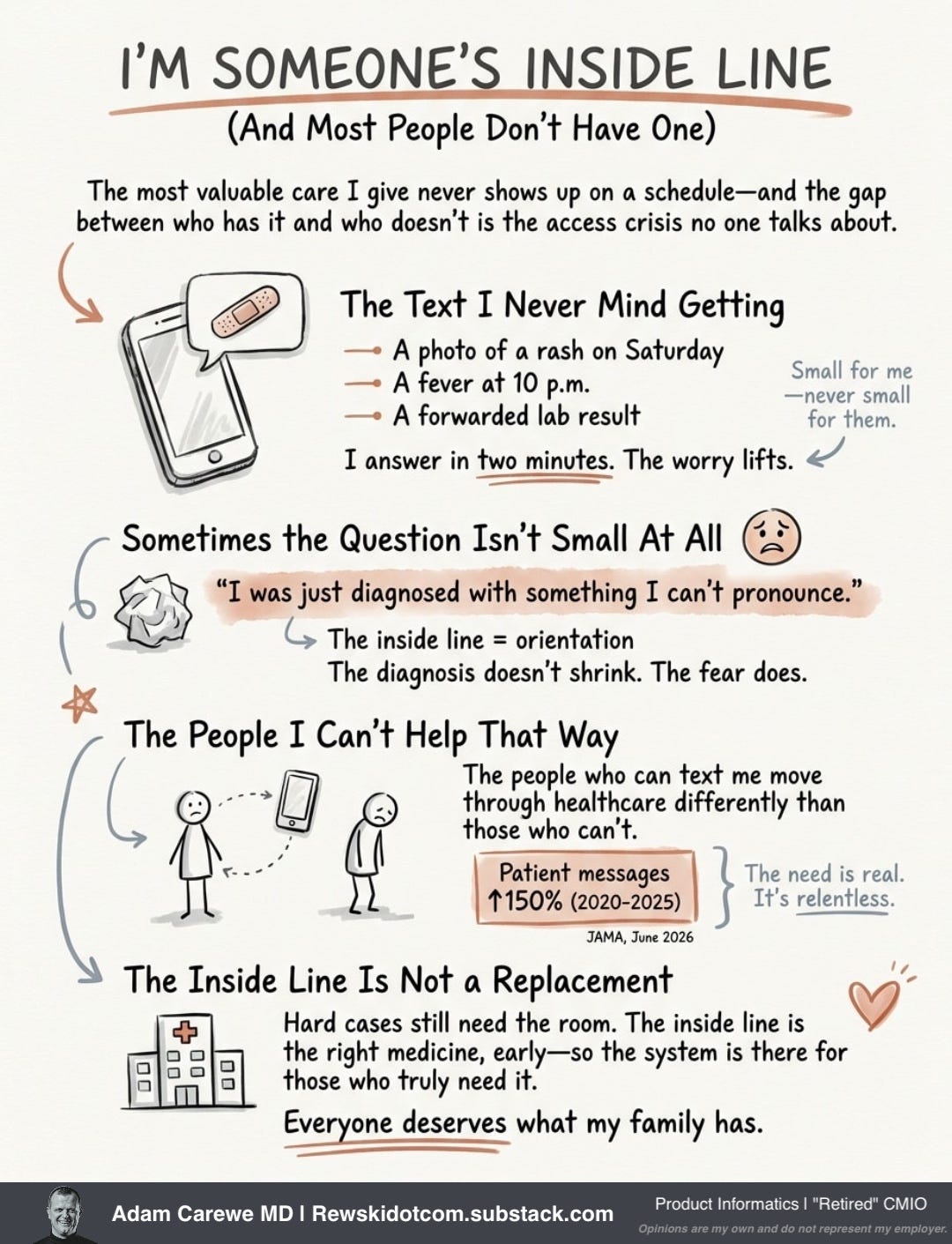
I am someone’s inside line. Friends text me a photo of a rash on a Saturday. A cousin sends a fever and a worried question at 10 p.m., asking whether the night is an emergency room night or a wait-until-morning night. Family forwards a lab result with one question that saves them a week of dread and a visit they did not want to make. I answer in two minutes. The worry lifts. Nothing gets booked. No one waits.
Here is the part I have come to understand. These questions are small for me. They are almost never small for the person asking. The fever at 10 p.m. is a parent standing alone in a hallway deciding whether their child is safe. The forwarded lab value is a week of fear compressed into one screenshot. What costs me two minutes is often the difference between a calm night and a quiet spiral into the worst version of the answer. The gap between how small the question feels to me and how large it feels to them is the whole reason the inside line matters.
It is the most satisfying medicine I practice. Low effort, high trust, the right answer at the right moment, before the small thing becomes a big one. The thing that makes it work is not my training. It is the ease. They trust me, and reaching me costs them nothing. That is trust-in-ease, and it quietly settles a thousand unmarked intersections before any of them ever reach a waiting room.
Sometimes the Question Is Not Small at All.
Not every text is a rash. Some of them are the hardest moments of a person’s life. I was just diagnosed with something I cannot pronounce. The scan showed a word the specialist said quickly and I did not absorb. What does my life look like now. Those are the ones that stay with me longest.
In those moments the inside line is not a quick answer. It is orientation. Someone to say what matters and what does not, what to ask at the next visit, that people live long and full lives with this. The diagnosis does not shrink. The fear around it does.
I have a strong conviction about this. A great deal of what makes a new diagnosis or a new chronic illness so frightening is not the disease itself. It is facing it with no trusted place to ask, and no one who has been there to learn from. Give a person a trusted place to put the question, and trusted answers to sit with, including from people who have walked the same road, and something heavy gets lighter. I have watched it happen one text at a time.
The People I Can’t Help That Way.
Here is what stays with me. The people in my life who can text me move through healthcare differently than the people who cannot. A quick answer keeps a small problem small. With no inside line, the same problem waits behind a phone tree and a calendar, and sometimes it grows while it waits.
I notice it most with the people who have no one. The patient who has never had a clinician in the family. The person newly diagnosed who has nobody to ask, alone with a search bar at 2 a.m., finding the scariest version of every answer. The friend of a friend who finally asks me something they have carried for months, and the relief on their face tells me how heavy it had been. That quiet channel is the most valuable health benefit I know of, and it appears on no insurance card. You either have someone to text or you do not.
I think about the inbox I used to have. The messages never stopped, and after hours was where most of them got answered. That swell is now measured. A JAMA study published this week tracked it across five years: patient portal messages rose about 150 percent between 2020 and 2025, and they now outpace in-person office visits. The paper also found the load and the benefit are not evenly shared. The need is real. It is also relentless, and it does not fit neatly into anyone’s eight hours.
What I Keep Coming Back To.
I do not have a tidy fix. I have a wish, and I have had it for more than ten years. I want everyone to have what my family has. A trusted place to ask, for the small questions and the large ones. Trusted answers to learn from, including from people who have lived the same thing. The relief of not facing the scary parts alone.
That is not a slogan and it is not a product pitch. It is the thing I would build and hand to everyone if I could, because I have watched what it does for the few people who already have it. It turns a system that feels like a wall into something that feels like a person.
One Thing the Inside Line Is Not.
It is not a replacement for real care. The hard cases still need the room. The procedure still needs the hands. The complex plan still needs a human to own it and sign it. The inside line is not less medicine. It is the right medicine, early, for the small and the resolvable, and a steady hand for the large and the frightening, so the room and the hands and the plan are there for the people who truly need them.
Thirty years after that chalkboard in 1996, I have stopped thinking of access as a scheduling problem. For me it comes down to something simpler and more human. Almost everyone I love has someone to text, for the rash and for the diagnosis alike. Almost everyone else does not. The day that gap closes, the best part of my job stops being a privilege a few people happen to have. I want more of what I do to feel like that text on a Saturday, for everyone, not just the lucky few who already have my number.
— Adam
If this resonated, more of how I think about care and building is in the archive.
Long JJ, McAdams-DeMarco MA, Schwartz MD, et al. Trends in patient portal messages, office visits, and telephone encounters. JAMA. June 22, 2026. doi:10.1001/jama.2026.8690.
The trusted place to ask may be one of primary care's greatest, and least appreciated, fiduciary responsibilities. Helping patients navigate uncertainty early creates value that's difficult to measure but fundamental to better care
I am an inside line as well. And I really worry about those who have no one to ask. Do you have an idea for a temporary solution? Something similar to a “crisis line” perhaps? We do it for mental health, suicide. Why not questions about physical health.