

Actionist
Daniel Lubetzky’s better framework lands harder when you’re inside a legacy system.

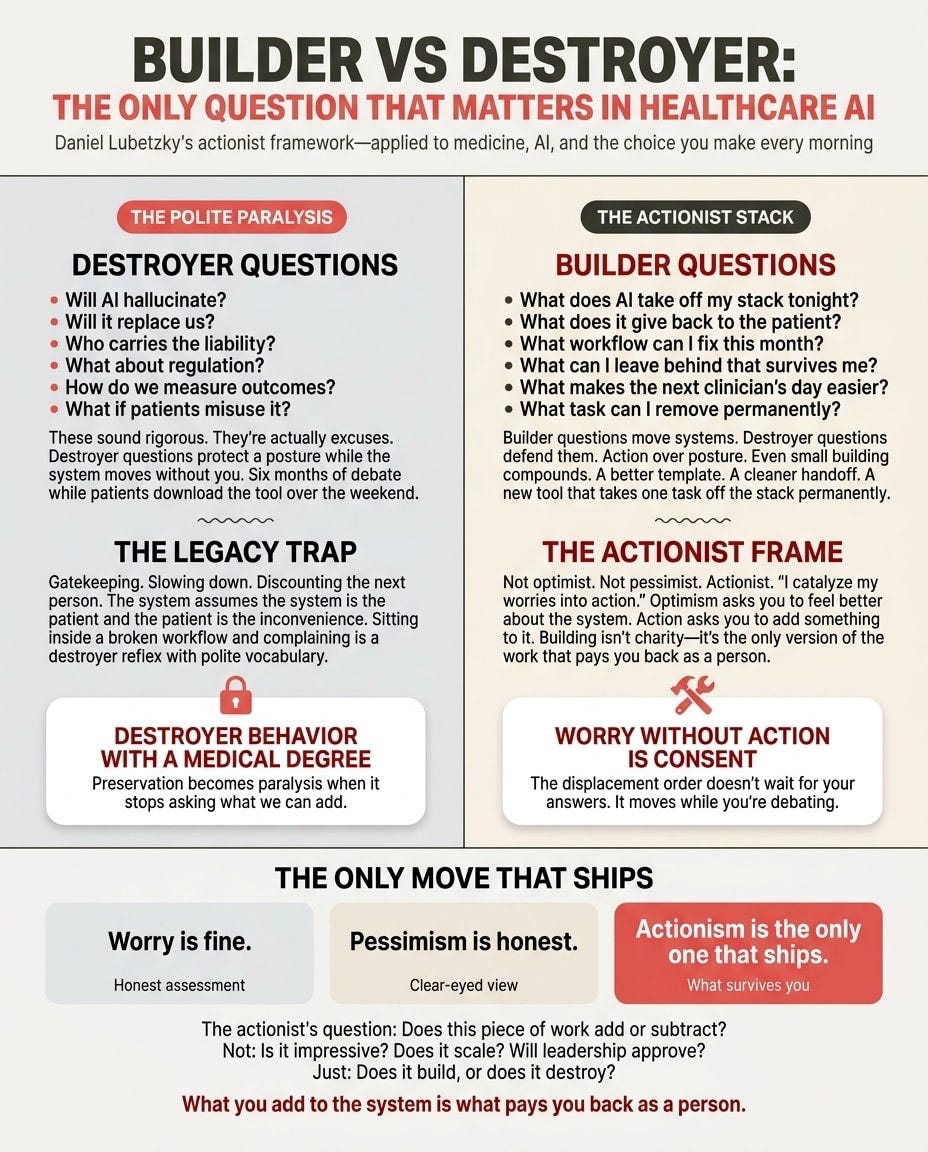
SUNDAY SHARE | BUILDING
I rewound the audio three times.
How I Built This is still my favorite podcast, and the Daniel Lubetzky episode covers his entire arc, from childhood through KIND. The whole hour is worth it. The part that stopped me was the last few minutes, when he set down a frame I have been circling without naming.
“I’m not an optimist. I’m also not a pessimist. I’m a worry all the time, but then I catalyze my worries into action. What I call an actionist.”
That word stayed with me into Monday.
The frame I needed
Lubetzky used to think the dividing line was moderates against extremists. He said that frame was incomplete. The better split is builders against destroyers.
A destroyer wakes up and asks how to divide, demolish, diminish. A builder wakes up and asks how to unite, how to add. The point is not optimism. The point is what you do with the worry.
That is a clean separation. Optimism asks you to feel better about the system. Action asks you to add something to it. Worry without action is a slow form of consent.
Why it landed
I do not work in a field that rewards optimism. I work in a field that rewards documentation. Charting is the closest thing modern medicine has to a religion. The system runs on it. The system is also exhausted by it.
Inside that environment, optimism is a posture. It does not change a schedule, a workflow, a panel size. It does not change what the EHR demands at 9:47 PM on a Tuesday.
Building does. Even small building does. A better template. A cleaner handoff. A workflow that respects the next clinician’s time. A new tool that takes one task off the stack permanently.
The actionist frame names what I have been doing on the side for two years. Worry, then build. Worry, then write. Worry, then ship.
Builder vs Legacy, in plainer terms
I have been writing about Builder vs Legacy as a healthcare and AI thesis. Lubetzky gave me the consumer-grade version of the same idea.
Legacy is not always destruction. Some of it is preservation, and preservation matters. But a lot of legacy behavior in medicine is closer to what Lubetzky called the destroyer reflex. It asks how to gatekeep, how to slow, how to discount the person on the other side of the table. It assumes the system is the patient and the patient is the inconvenience.
Builder behavior asks the inverse question. What can I add. What can I make easier for the person who shows up tomorrow. What can I leave behind that survives me.
The reframe is not anti-legacy. It is anti-passive. Sitting inside a broken workflow and complaining about it is a destroyer reflex with a polite vocabulary.
The AI cut
Lubetzky’s frame sharpens what is happening with AI in medicine right now. The destroyer questions about AI sound rigorous. Will it hallucinate. Will it replace us. Will the liability fall on the physician. Each one is fair. Each one also doubles as an excuse to do nothing.
The displacement order does not wait for the answers. It moves while we are debating them.
The builder question is different. What does AI take off my stack tonight. What does it give back to the patient in the chair tomorrow. What workflow do I touch this month that costs the next clinician less than it cost me.
The destroyer questions protect a posture. The builder questions move a system.
I have watched colleagues spend six months explaining why a tool will not work. The tool, meanwhile, is in the hands of patients who downloaded it last weekend. The actionist frame says the worry was correct. The behavior around it was the problem.
The actionist’s question
The line that hit hardest was the simplest one. Lubetzky said the overwhelming majority of us want to be builders. We want to put positive things into the world for our children. Then he closed the loop. We are not doing it for somebody else’s sake. We are doing it for our own.
That is the part I keep returning to. Building is not charity. It is not a side project that excuses the day job. It is the only version of the day job that pays you back as a person.
The question I am sitting with this week is whether each piece of work I do is a builder move or a destroyer move. Not whether it is impressive. Not whether it scales. Whether it adds, or whether it subtracts.
Worry is fine. Pessimism is honest. Optimism is fashionable.
Actionism is the only one that ships.
Nash (one of my dogs) does not care which frame I use. He cares whether I am off the laptop by sunset. He is the most consistent actionist in the house.
— Adam
If this resonated, the builder-substrate take on regulating vs building is the natural next read: The Framework Isn’t New